
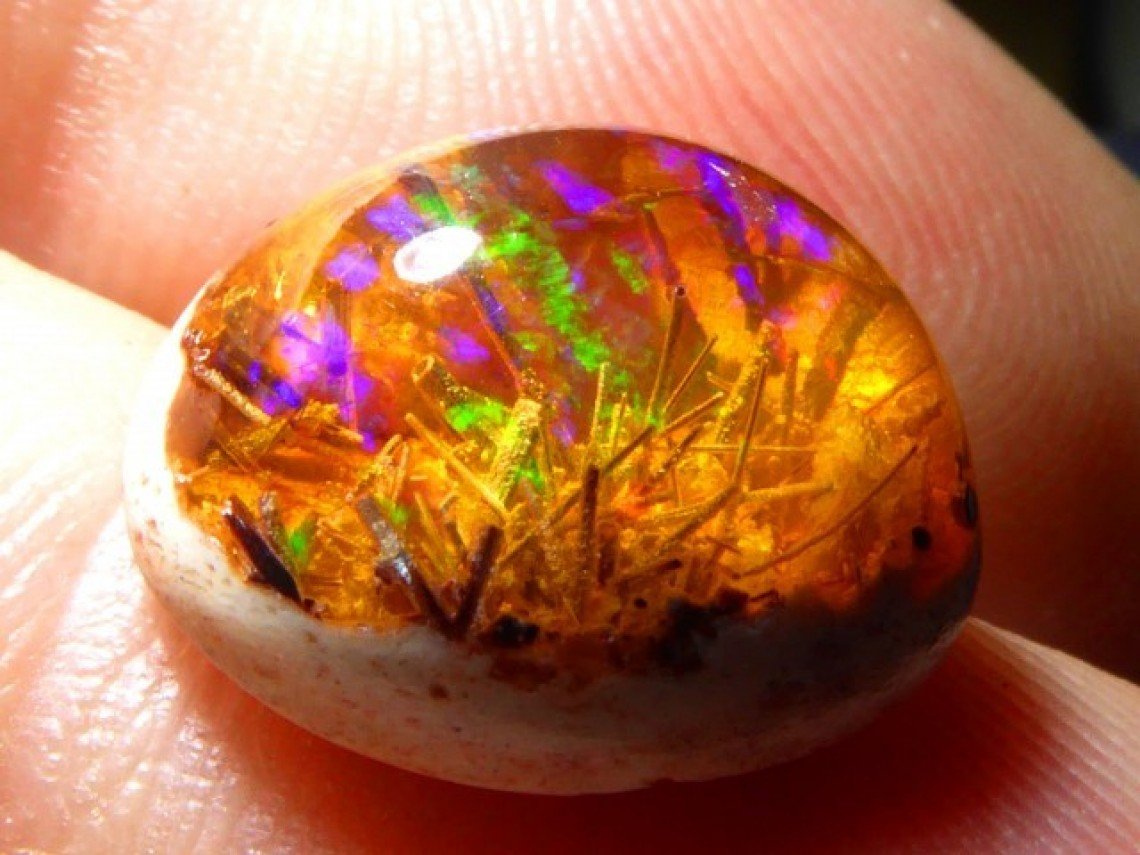
These three types of opal are all very different from one another. It wasn't until recently that we understood how…
These three types of opal are all very different from one another. It wasn’t until recently that we understood how each differed from one another, and from traditional opals.
Yowah Nut Opal

Yowah nut opal are really small boulder opals that look roughly like a nut from a tree. They can be as small as an apricot seed or as large as a Mango seed. When the “nut” opens up it reveals layers of brown, roundish patterns much like a lemon peel that eventually, as you get to the center of the stone, end up in either an empty cavity or an area filled with opal.
How the ‘kernel’ of the nut get filled with precious opal? That was a complete mystery until geologists and others worked out that a long time in the past the boulder ironstone ‘nuts’ were not as hard as they are today. In fact, at one stage of the development they were quite porous, allowing a mater based chemical mix, seep down into them. In time, this chemical ‘soup’ containing silica, dried out and left a residue which ended up being either common or precious opal.
Phantom Ghost Opals
Some Ethiopian opals have a natural Phantom ghost. These opals are called Phantom Ethiopian opals and are also known as Ghost Phantom Opals.
It is thought that Ethiopian opal is formed differently than sedimentary opal and this allows for this unique ghost inclusion in these opals. It does not form in any other opals. Most are formed with smooth coverage inside the opal but the more rare ghosts are ones formed like bubbles or cloud formations.
The Opal is mostly transparent crystal opal on the outside layer and the inner ghost cloud like inclusion is inside the crystal shell of the opal. The Ghost phantom can be milky white to grey and black or even semi translucent in itself. It does not affect the overall color of the crystal fire and sometimes it looks like the ghost can have opal colors but this is the crystal around the ghost that gives this effect.

There are so many different names in use for this type of opal: fire opal, jelly opal, crystal opal, cherry opal. The final mysterious opal is unique Mexican Opal that has brilliant fire colour but also has rutillated needles inside the Opal. It is really a mystery on how this Opal was formed this way. Opal is silica and Mexican Opal is volcanic, so to have rutilated needles form inside the silica or Opal it needed to have cavities.

Interested in more stories like this? Join Us On Social Media.



We send periodic email announcements and a monthly newsletter with clips to our favorite News & Events stories. Subscribe today.
[salesforce form=”2″]
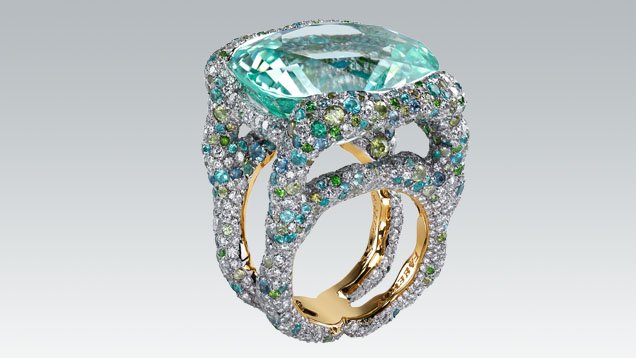
It was often confused with other gems, due to a wide range of colors. Tourmaline is October's "other" birthstone.

In the 1500s, a Spanish conquistador somewhere in Brazil confused green tourmaline crystal with emerald. That confusion lived on until scientists recognized tourmaline as a distinct mineral species in the 1800s. The confusion about the stone’s identity is reflected in its name – Tourmaline is derived from the Sinhalese toramalli, which means “mixed gems”.

It’s easy to understand why people confuse tourmaline with other gems: the stone has a dazzling range of colors, from rich reds to pastel pinks and peach colors, intense emerald greens to vivid yellows and deep blues. People have probably used tourmaline as a gem for centuries, but they identified it as some other stone (ruby, sapphire, emerald, and so forth) based on its coloring.
In the late 1800s, tourmaline became known as in America as a result of the efforts of Tiffany gemologist George F. Kunz. He wrote about the tourmaline deposits of Maine and California, and praised the stones they produced. Tourmaline’s biggest market at the time was China. Much of the pink and red tourmaline from San Diego County in California was shipped to China because the Chinese Dowager Empress Tz’u Hsi was especially fond of the color. There, craftsmen carved the tourmaline into snuff bottles and other pieces to be set in jewelry.

Tourmaline’s colors have many different causes. One of tourmaline’s most sought-after and generally available colors is the pink/red variety known in the trade as rubellite. Green tourmaline’s pastel hues are alternatives to the deep, rich hue of emerald and the softer green of peridot. At their best, green tourmalines are transparent, brilliant, and clean, with attractive bluish green hues. Stones that show attractive colors in both directions—such as bright green in one and blue in another—are the most valuable.
Since it was discovered in the late 1980s, Paraíba tourmaline’s striking neon blues and greens have electrified the gem world. The gem’s unique, vivid coloring instantly set it apart from other tourmalines. Paraíba tourmalines appear in a range of greenish blue, bluish green, green, blue, and violet hues. Because of the rough’s high value, Paraíba tourmalines are almost always custom cut. With Paraíba, however, color is the key factor, not size. So all other factors being equal, the gem with the better color is a better choice.
Cutters often fashion tourmalines as long rectangles. Making the cut parallel to the length of the rough crystal helps to reduce waste. But cutters also have to consider tourmaline’s optical properties – it can show different colors in different crystal directions. A crystal that appears pale green across its width can be very dark green—sometimes almost black—when you look down its length.
Tourmaline can be featured in many different types of custom jewelry, and is especially good for pieces with vibrant colors. Contact us for a consultation today and see how tourmaline could work for you!

Source: GIA.edu
Interested in more stories like this? Join Us On Social Media.
We send periodic email announcements and a monthly newsletter with clips to our favorite News & Events stories. Subscribe today.
[salesforce form=”2″]
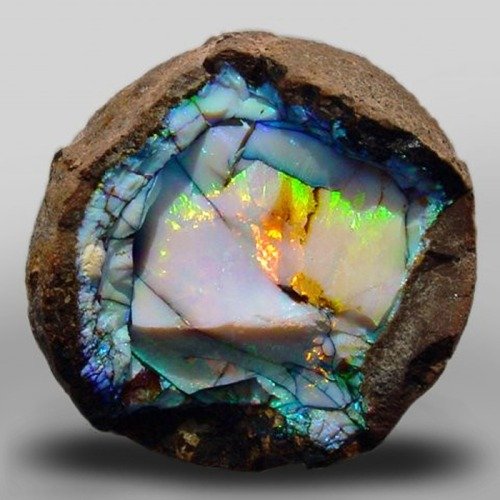
Opal is the birthstone for October, and Australia's National Gem.
 During dry periods, much of the water evaporated, leaving solid deposits of silica in the cracks and between the layers of underground sedimentary rock. Those silica deposits formed opal. So opal is actually a hardened gel, as opposed to a gemstone.
There are two broad classes of opal: precious and common. Precious opal displays a unique display of flashing rainbow colors called play-of-color, common opal does not. That play-of-color occurs in precious opal because it’s made up of sub-microscopic spheres stacked in a grid-like pattern—think layers of Ping-Pong balls in a box. As lightwaves travel between the spheres, the waves bend, breaking up into the colors of the rainbow, called spectral colors.

The colors we see when we look at the opal vary according to the (microscopic) size of those spheres. Approximately 0.1 micron (one ten-millionth of a meter) in diameter produces a violet color. At 0.2 microns in size we see red. In between is the rest of the rainbow.

White or light opal is translucent or semitranslucent. It’s play-of-color shows against a white or light gray background or body color.
Black opal can range from translucent to opaque, with play-of-color against a black or dark background.
Fire opal is transparent to translucent, but has brown, yellow, orange, or red body color. Fire opal often doesn’t show any play-of-color. It is also known as “Mexican opal.”

Boulder opal can range from translucent to opaque, with play-of-color against any background from light to dark. It’s known as boulder opal because fragments of the surrounding rocks or boulders are part of the finished gem.
Crystal or water opal is transparent to semitransparent, and has a clear background. The clear background of the crystal or water opal creates exceptional play-of-color displays.
A large percentage of the world’s opal comes from three distinctive regions in Australia, Lightning Ridge (the home of black opal) the South Australian fields of Coober Pedy, Mintabie, Lambina and Andamooka (the main sources of light base opal) and the Queensland fields, where boulder opal originates.
Solid opals can be found in Brazil, Mexico, Honduras as well as Peru and Tanzania Africa. Ethiopian opals have been a recent find for opal lovers. The crystal opals from the Welo region are very popular due to their bright patterns.

The major opal producing field for black opal is Lightning Ridge in New South Wales, Australia. Opal from Lightning Ridge is often considered to be the best and brightest in the world. The most sought after black opal is red or multicolor on black, which is very difficult to find. Such stones are always cut on the fields and sold immediately. “The Path of Enlightenment” necklace contains 180 magnificent opals from Lightning Ridge.

Earlier this year, gem-quality common opal was discovered in Michoacán State in western central Mexico. These opals were embedded in volcanic andesitic rocks. They were generally characterized by a medium to light orange to brown color, with no visible inclusions. While these new deposits are considered “common opal” since the material does not show play-of color, some gemologists may also consider the specimens to be fire opal due to the orangy bodycolor.
Another relatively new source for precious opal is located in Ethiopia’s Wollo Province. It produces opals with vibrant play-of-color and interesting inclusions.
Source: GIA.edu, National Gemological Society
Interested in more stories like this? Join Us On Social Media.
We send periodic email announcements and a monthly newsletter with clips to our favorite News & Events stories. Subscribe today.
[salesforce form=”2″]
Australian mines were the origin of the most famous opals in history. The Olympic Australis At 11 inches long, 4 ¾ inches tall and 4 ½ inches wide,…
Read story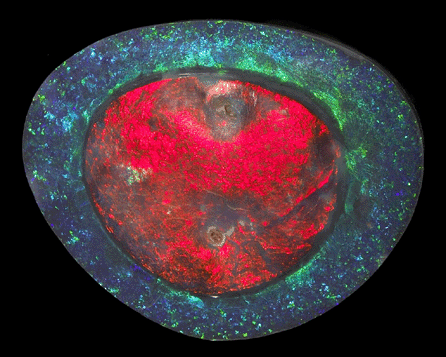
Australian mines were the origin of the most famous opals in history.

The Olympic Australis
At 11 inches long, 4 ¾ inches tall and 4 ½ inches wide, the Olympic Australis is the largest gem opal in the world. It weighs 17,000 carats (3.45 kg). The Olympic Australis was found in 1956 at a mine in South Australia’s Coober Pedy. That year the Olympic games were being held in Australia, so the miner decided to name the gem after the Olympic games.
The Aurora Australis
The Aurora Australia is the most valuable black opal in the world. The gem was found in Lightening Ridge, in NSW. Altmann & Cherny brought it in a semi rough state and they later cut and polished it into a harlequin pattern. The opal has a black background, interspersed with green, blue and red colours. The gem was named Aurora Australis after the southern lights. The value of the gem is estimated at AUD1,000,000.

The Queen’s Opal
The Queen’s Opal, also known as the Andamooka Opal, was chosen by the government to present to Queen Elizabeth II when the queen was slated to visit Australia for the first time. It shone with blue, green and red colors, and was later set into a palladium necklace.
The Pride of Australia
The Pride of Australia, or Red Emperor, was discovered in 1915 at a mine known as Phone Line. It is called the Pride of Australia because its shape resembles that of the continent. The opal has blue and black veins, interspersed with red streaks. Unfortunately, the Pride of Australia was stolen from a display at the Forest Lawn Memorial Museum in 1961. It has never been recovered.

The Halley’s Comet Opal
The Halley’s Comet Opal was so named because it was mined in 1886, a year that the Halley’s Comet was seen. This uncut black opal, the largest one found to date, was unearthed at Lightening Ridge, NSW.
There have also been many famous people who were enamored with opals.
Andy Warhol, one of the most recognized artists of the modern world, fell hard and fast into his love affair with this magnificent gemstone. He became an avid collector, and in 1977 Warhol featured photos of the

gemstone taken through a microscope at his exhibition Opal the Rainbow Gem at the ICA in London.
A Senator of the Roman Republic, Nonius, owned a fabulous Opal. The opal was set in a ring, and is said to have been the size and shape of a hazelnut. Roman General Mark Antony was so entranced by the moving lights within Nonius’ opal, his fascination led him to covet the stone which he sought as a gift for his lover Cleopatra. Antony offered Nonius several times the 2,000,000 Sesterces at which the Opal ring had been appraised, however Nonius refused to sell it, declaring it was his life. Nonius preferred to be banished from Rome losing all he owned, then to part with the opal.
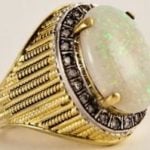
A massive 14k vintage opal ring featuring a huge crystal opal surrounded by diamonds, was purchased by Elvis Presley in the early 1970’s. It was worn both on and off stage.
John Davison Rockefeller, America’s first billionaire and the world’s richest man, was taken by the alluring charms of Opals. He paid a record price for the mesmerizing ‘Fire Queen’ Opal.
Sarah Bernhardt was on of the most famous actresses of her time. She commissioned this ruby-eyed snake bracelet and ring (hathphul), inlaid with Opals, for her premiere as Cleopatra.
Interested in more stories like this?
Follow us on Facebook. Follow us on Twitter.
We also send a monthly newsletter with clips to our favorite News & Events stories. Subscribe today.
[salesforce form=”2″]
Source & Image Credits: GIA.edu
Opal is the national gemstone of Australia and the birthstone for the month of October. The most striking feature of opal is the ability to refract and reflect…
Read story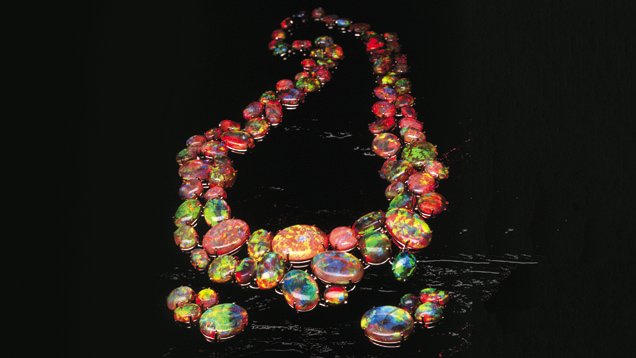
Opal is the national gemstone of Australia and the birthstone for the month of October. The most striking feature of opal is the ability to refract and reflect specific wavelengths of colors. In fact, the term “opalescence” was coined to describe this phenomenon. The size and spacing of spheres of silica within the stone refract specific wavelengths of light; each sphere refracting a single, pure spectral color much like the droplets of water in a rainbow. The interplay of these pure wavelengths of light gives opal a unique visual.

Most opal is more than 65 million to 145 million years old. It is found in the Cretaceous layer of rock, formed when dinosaurs roamed the earth. Opal tends to be found near the earth’s surface in areas where ancient geothermal hot springs once flowed. The minerals bubbled up from beneath the surface of the earth and slowly over centuries lined the walls of cavities in the bedrock.
Opal is derived from the Latin word Upala that relates to precious stones and was considered the “cupid paederos” or child as beautiful as love. For Roman scholars, the opal represented hope and purity, a concept later adopted by modern Asian countries who consider the opal as a symbol of hope. The opal that the Romans referred was crystal formed volcanic gemstones in the Carpathian Mountains. It featured flashes color that was not seen anywhere else in the ancient world and really impressed the Romans. Ancient Greeks believed opal had the power to have sixth sense in foresight and also prosperity.

The Roman historian Pliny described opal as the queen of gems: “There is in them a softer fire than the ruby, there is the brilliant purple of the amethyst, and the sea green of the emerald – all shining together in incredible union. Some by their splendor rival the colors of the painters, others the flame of burning sulphur or of fire quickened by oil.”
Native Australian aborigines’ considered opal to have spiritual properties and have many myths and legends about Opal. They believed opal holds signs of their past ancestors and a spirit named Muda, who changes from man to pelican so pelican birds are considered spiritual also. Asian countries had experienced opals from Indonesia and appreciate the color spectrum of opals. The opal has been considered as a gemstone of hope and security in Asian countries. Japanese buy opals as show of wealth and standing in the community, and prefer perfectly formed gem quality even if the opal is small.

A large percentage of the world’s opal comes from three distinctive regions in Australia, Lightning Ridge (the home of black opal) the South Australian fields of Coober Pedy, Mintabie, Lambina and Andamooka (the main sources of light base opal) and the Queensland fields, where boulder opal originates. The major opal producing field for black opal is Lightning Ridge in New South Wales, Australia. Opal from Lightning Ridge is often considered to be the best and brightest in the world. The most sought after black opal is red or multicolor on black, which is very difficult to find. Such stones are always cut on the fields and sold immediately.
Check out these magnificient opal earrings available in our Fine Jewelry collection.

Next week we’ll share on some of the more famous opals through history.
Interested in more stories like this?
Follow us on Facebook. Follow us on Twitter.
We also send a monthly newsletter with clips to our favorite News & Events stories. Subscribe today.
[salesforce form=”2″]